
Diese dient lediglich Demonstrationszwecken.
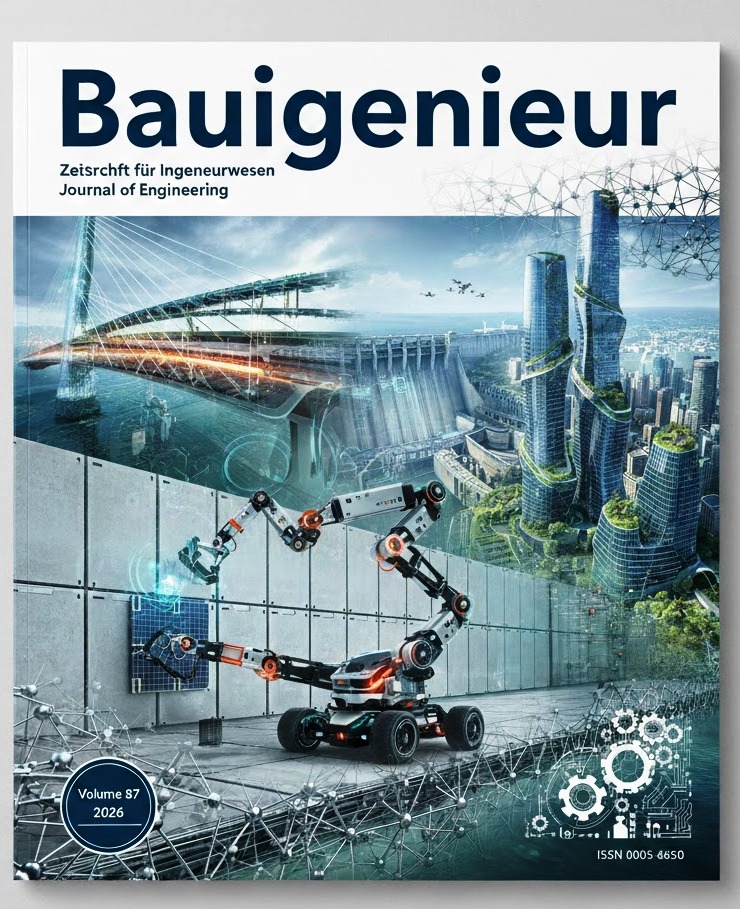

BAUINGENIEUR journal recognized as Traditional “trade journal” list due to its large-scale popularity and long-time continuous publication of research articles. BAUINGENIEUR stands as a cornerstone of Civil Engineering, Mechanical Engineering, Electrical Engineering, Chemical Engineering, Environmental Engineering, Materials Science, Aerospace Engineering, Industrial Engineering, Renewable Energy Engineering, Electronics Engineering, Mechatronics Engineering, Structural Health Monitoring, Green Building Technology, Computational Engineering, Engineering Sustainability.
This prestigious journal delivers authoritative insights into bridge engineering, high-rise construction, sustainable infrastructure and seismic resilience, serving decision-makers, researchers, and practitioners worldwide.
With a century-long legacy, BAUINGENIEUR Journal showcases ground-breaking projects—from iconic suspension bridges to eco-friendly urban redevelopment—alongside rigorous analyses of mechanics, finite element modeling, and BIM integration.
This journal publish peer-reviewed research articles to advance knowledge. This Peer-reviewed journals adopt a rigorous evaluation process where submitted manuscripts are assessed by independent experts, in the same field to ensure quality, validity, originality and relevance before publication. It follows a double-blind peer review process in which both the authors’ and reviewers’ identities are concealed from each other to minimize bias.
Current Issue
Volume-87, Issue-6, June 2026
Research article, Type: Subscription; Page: 01-12;
Received: 18 February 2026 / Revised: 26 March 2026 / Accepted: 15 May 2026 / Published: 01 June 2026
Title: Synthesis and Characterization of Novel Biodegradable Polymers Derived from Rice Husk and Cassava Peels for Commercial Food Packaging
Author: Juntem Yam, Tuijun Wang, Zinran Dong, Lenhao Zhou, Ivan Matnez-Vatuena & Dugge Yang
Abstract: The accumulation of single-use, petroleum-based plastics poses a severe threat to global ecosystems, necessitating the development of sustainable, bio-based alternatives. This study explores the synthesis of novel biodegradable polymer films utilizing agricultural waste—specifically, cellulose extracted from rice husks and starch from cassava peels. The research outlines a scalable, low-impact chemical extraction and film-casting process. The resulting biopolymers are subjected to comprehensive characterization, including tensile strength testing, water vapor permeability, and thermal stability analysis. Additionally, soil burial degradation assays are conducted to measure the environmental breakdown rate of the materials over a 90-day period. The findings aim to demonstrate that agro-waste-derived bioplastics can achieve mechanical and barrier properties comparable to conventional synthetic plastics, thereby offering a viable, circular-economy solution to plastic pollution and agricultural waste management.………….. [For more click here]
Keywords: Biopolymers, Sustainable Packaging, Agricultural Waste Valorization, Cellulose Extraction, Circular Economy, Biodegradability
Research article, Type: Subscription; Page: 13-27;
Received: 20 January 2026 / Resubmitted: 24 April 2026 / Revised: 12 May 2026 / Accepted: 24 May 2026 / Published: 01 June 2026
Title: Investigation of Vibration Mitigation Parameters for Superior Surface Integrity in High-Speed CNC Milling
Author: Avinash Kumar, Abhishek Kumar Sharma, Manish Kumar, Akash Kashyap, Pankaj Kumar, Sanjeev Kumar Sajjan, Nikhil Kumar Mahraur, Rajay Reddy K
Abstract: High-speed CNC milling is widely used in precision manufacturing, but vibration remains a major challenge because it can degrade surface integrity, reduce dimensional accuracy and accelerate tool wear. This paper presents a study of vibration mitigation parameters in order to improve surface quality in high-speed CNC milling. The objective is to identify the process parameters that minimize chatter and lead to better machined surfaces. The effects of cutting and mitigation parameters on vibration behaviour and surface response were investigated through a structured experimental methodology. The machining trials were performed by measuring the vibration signals in the time and frequency domains and the surface integrity was measured by roughness and other quality indicators. The results indicated that effective vibration mitigation can reduce oscillatory instability and suppress peaks associated with chatter, which improves the surface finish due to more stable chip formation. The findings confirm that vibration control is a direct route to better surface integrity in high-speed CNC milling rather than a secondary process adjustment. .………….. [For more click here]
Keywords: CNC milling, Vibration mitigation, Chatter suppression, Surface integrity, Surface roughness, Machining dynamics
Research article, Type: Subscription; Page: 28-43;
Received: 27 February 2026 / Resubmitted: 28 April 2026 / Revised: 15 May 2026 / Accepted: 31 May 2026 / Published: 02 June 2026
Title: Effects of Deep Cryogenic Treatment on the Microstructural and Thermal Properties of Copper Chill Plates
Author: Veborah Horn, Teena Favier, Rallan bell, Dehby Tandi & Donald Darant
Abstract: Copper chill plates are critical components in directional solidification processes, requiring exceptional thermal conductivity and wear resistance to maintain strict thermal gradients. This research explores the effects of Deep Cryogenic Treatment (DCT) at -196°C on the microstructural evolution and thermomechanical performance of commercial-grade copper chill plates. Samples were subjected to varying holding times at cryogenic temperatures, followed by controlled tempering Microstructural characterization via Scanning Electron Microscopy (SEM) and X-ray Diffraction (XRD) revealed a significant reduction in residual stresses and the refinement of grain structures. Thermal conductivity measurements demonstrated a measurable enhancement in the DCT-treated samples compared to conventionally treated counterparts. Furthermore, the surface hardness and wear resistance were notably improved, prolonging the operational lifespan of the chill plates under cyclic thermal loading. These findings suggest that deep cryogenic treatment is a highly effective, post-fabrication process for optimizing the thermal management capabilities of copper chill plates in advanced casting applications. .………….. [For more click here]
Keywords: Deep Cryogenic Treatment, Copper Chill Plates, Thermal Conductivity, Microstructural Refinement, Directional Solidification