
Diese dient lediglich Demonstrationszwecken.
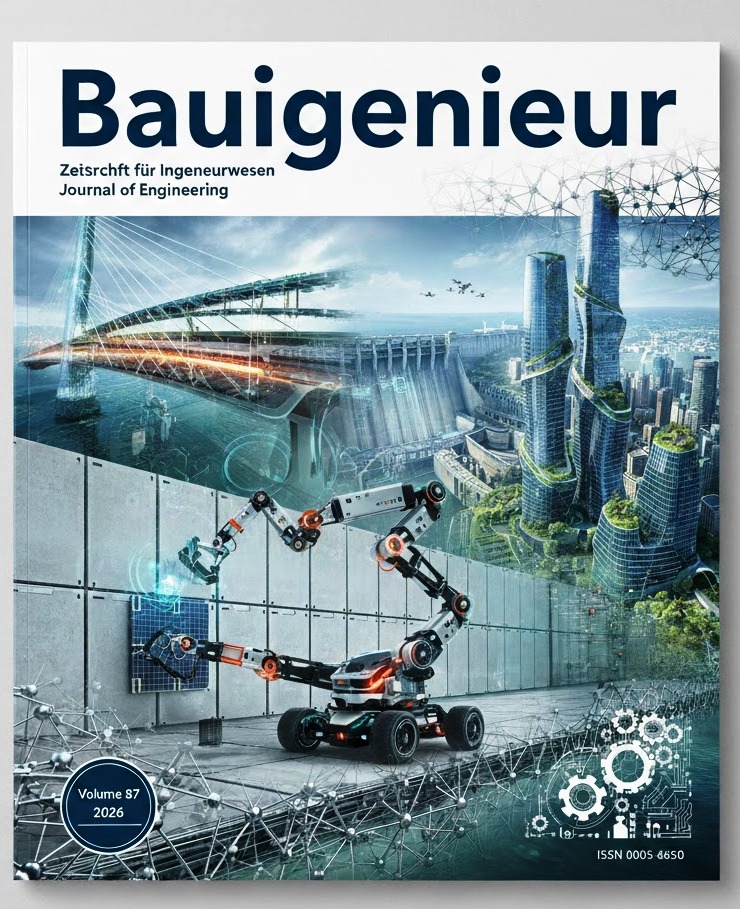

BAUINGENIEUR journal recognized as Traditional “trade journal” list due to its large-scale popularity and long-time continuous publication of research articles. BAUINGENIEUR stands as a cornerstone of Civil Engineering, Mechanical Engineering, Electrical Engineering, Chemical Engineering, Environmental Engineering, Materials Science, Aerospace Engineering, Industrial Engineering, Renewable Energy Engineering, Electronics Engineering, Mechatronics Engineering, Structural Health Monitoring, Green Building Technology, Computational Engineering, Engineering Sustainability.
This prestigious journal delivers authoritative insights into bridge engineering, high-rise construction, sustainable infrastructure and seismic resilience, serving decision-makers, researchers, and practitioners worldwide.
With a century-long legacy, BAUINGENIEUR Journal showcases ground-breaking projects—from iconic suspension bridges to eco-friendly urban redevelopment—alongside rigorous analyses of mechanics, finite element modeling, and BIM integration.
This journal publish peer-reviewed research articles to advance knowledge. This Peer-reviewed journals adopt a rigorous evaluation process where submitted manuscripts are assessed by independent experts, in the same field to ensure quality, validity, originality and relevance before publication. It follows a double-blind peer review process in which both the authors’ and reviewers’ identities are concealed from each other to minimize bias.
Current Issue
Volume-87, Issue-10, Octuber 2026
Research article, Type: Subscription Tier-I; Page: 01-18;
Received: 10 June 2026 / Revised: 25 August 2026/ Accepted: 18 September 2026 / Published: 03 October 2026
Title: Hydrodynamic Modeling of Nature-Based Coastal Barriers Compared to Concrete Seawalls for Sustainable Sea-Level Rise Flood Mitigation
Author: Kirestoffer Desuja, Warren Rocca & David Maroun
Abstract: Accelerating sea-level rise and intense tropical storms pose unprecedented flooding threats to vulnerable coastal civil infrastructure installations. Traditional rigid concrete seawalls are expensive to construct and often cause severe ecological damage to marine habitats. This study utilizes advanced hydrodynamic software to simulate the protective performance of nature-based coastal engineering defenses. The research models how engineered mangrove wetlands and living oyster breakwaters dissipate incoming storm wave energy. Simulated flood mitigation efficiency will be directly compared against standard vertical concrete infrastructure layouts under extreme weather scenarios. The final data aims to guide coastal engineers in designing self-healing, ecologically sustainable shoreline boundaries….………….. [For more click here]
Keywords: Coastal engineering, Flood mitigation, Nature-based solutions, Climate resilience
Doi (Journal): 10.1045/2026.Bauingenieur/108805-VDI_002
Research article, Type: Subscription Tier-II; Page: 19-34;
Received: 21 May 2026 / Revised: 26 September 2026/ Accepted: 03 October 2026 / Published: 10 October 2026
Title: Improving the Coefficient of Performance in Refrigeration System through Condensate-Assisted Condenser
Author: Rajay Reddy K, Md Waquar Shahid, Nidhi Sneha Bara, Dipika Sinha & Sandeep Kumar Gupta
Abstract: This study investigates how spraying condensate water onto the condenser of a vapor compression refrigeration system (VCRS) affects its performance, especially under hot ambient conditions. In high temperatures, condenser pressure and compressor work rise, lowering the system’s coefficient of performance (COP) and efficiency. To counter this, condensate water collected from the evaporator is pumped—using a solar-powered pump—onto the condenser surface. As the sprayed water evaporates, it provides evaporative cooling, reducing condenser temperature and improving overall system efficiency. Experiments were conducted in Paris, France, using a split-type air conditioner equipped with thermocouples, pressure gauges, and electrical meters to monitor
performance before and after implementing the spray technique. Results showed significant improvements: the average actual COP increased from 2.37 to 3.42 (a 44% rise), electrical power consumption dropped by 13.8%, and the specific cooling effect improved by 22.2%, indicating enhanced cooling capacity. Condenser cooling performance also improved markedly. Key factors influencing system performance included spray rate, ambient temperature, and humidity. The method proved sustainable and cost-effective, as it recycles water generated within the system itself. Overall, the condensate water spray technique offers a practical, energy-saving solution to boost COP, reduce power usage, and enhance thermal performance in refrigeration systems operating under hot climatic conditions…..………….. [For more click here]
Keywords: Vapor Compression Refrigeration System (VCRS), Condenser Efficiency, Evaporative Cooling, Coefficient of Performance (COP), Energy Consumption
Doi (Journal): 10.1045/2026.Bauingenieur/108805-VDI_005
Research article, Type: Subscription Tier-I; Page: 35-52;
Received: 21 March 2026 / Revised: 04 August 2026/ Accepted: 01 October 2026 / Published: 12 October 2026
Title: Design and Kinematic Modeling of a Soft Robotic Actuator Integrated with Shape Memory Alloy (SMA) Wires for Minimally Invasive Surgical Interventions
Author: Arnold Auro
Abstract: Traditional rigid robotic tools used in minimally invasive surgery face strict limitations when navigating complex, high-curvature anatomical pathways without damaging surrounding soft tissues. To overcome this limitation, this research focuses on the design, fabrication, and kinematic evaluation of a bio-inspired, multi-degree-of-freedom soft robotic actuator. Constructed from a highly flexible silicone elastomer, the actuator embeds antagonistic pairs of Shape Memory Alloy (SMA) wires that serve as artificial muscles. Actuation is achieved via controlled Joule heating, allowing for precise, multi-directional bending. We develop a modified piecewise constant curvature (PCC) kinematic model integrated with a thermal-mechanical constitutive equation to accurately predict the actuator’s trajectory. Experimental testing demonstrates that the actuator can achieve a bending angle of up to 145 degrees with a positioning accuracy of ±0.6 mm, proving its potential to enhance safety and maneuverability in delicate endoscopic procedures.…..………….. [For more click here]
Keywords: Soft Robotics, Shape Memory Alloys (SMA), Kinematic Modeling, Medical Devices, Elastomer Actuators
Doi (Journal): 10.1045/2026.Bauingenieur/108805-VDI_007
Research article, Type: Subscription Tier-I; Page: 53-69;
Received: 02 June 2026 / Revised: 06 August 2026/ Accepted: 28 September 2026 / Published: 17 October 2026
Title: Additive Manufacturing of Bio-Inspired Fiber-Reinforced Concrete Matrixes
Author: Fangzhou Wang, Xing Zha, Ji Xingping, T.K. Wong & R. Fricky
Abstract: The emergence of 3D concrete printing (3DCP) has revolutionized civil construction by eliminating formwork and reducing material waste, yet printed concrete inherently suffers from low tensile strength and weak inter-layer bonding. This research addresses these mechanical vulnerabilities by developing a bio-inspired, fiber-reinforced concrete matrix optimized for continuous additive manufacturing extrusion. Drawing design principles from the hierarchical, fracture-resistant microstructure of natural nacre (mother-of-pearl) and bone, this study introduces short, high-tensile polymeric and metallic fibers into the cementitious mix. A customized mechanical extrusion nozzle is engineered to dynamically align these fibers parallel to the printing path during deposition, drastically increasing the material’s anisotropic tensile performance. The research rigorously analyzes the rheology of the fresh concrete mix to ensure pumpability and shape retention, alongside evaluating the mechanical shear strength at the interface between printed layers. Mechanical testing—including three-point bending and uniaxial compression tests—reveals that the bio-inspired fiber alignment yields a significant increase in fracture toughness and post-cracking energy absorption compared to conventionally cast or randomly oriented fiber concrete. This interdisciplinary study harmonizes mechanical fluid dynamics and robotic extrusion control with civil material science, paving the way for highly resilient, architecturally complex, and structurally independent printed civil infrastructure…..………….. [For more click here]
Keywords: 3D Concrete Printing, Fiber Alignment, Bio-inspired Materials, Fracture Toughness, Extrusion Rheology
Doi (Journal): 10.1045/2026.Bauingenieur/108805-VDI_012
Research article, Type: Subscription Tier-II; Page: 70-86;
Received: 11 July 2026 / Resubmitted: 01 September 2026/ Revised: 09 October 2026/ Accepted: 13 October 2026/ Published: 22 October 2026
Title: Design Optimization of Fly Ash-Stabilized Pavements on Expansive Soil
Author: Vicky Anand, Amit Kumar Sinha, Akanksha Kesharwani, Sakshi Gupta, Ranajeet Kumar, Suman Kumari, Shashi Ranjan & Akash Sharma*
Abstract: Expanding water-bound macadam (WBM) or bituminous rural road networks over weak subgrade formations, such as expansive soils, typically compromises structural longevity due to recurring moisture-induced swelling and shrinkage. High maintenance overheads combined with restricted budget allocations call for economic, alternative pavement designs. This research explores the geo-structural stabilization of expansive clay using fly ash sourced from the National Thermal Power Corporation (NTPC) facility in Solapur, Maharashtra, India. Laboratory tests were systematically carried out on soil blended with varying fly ash dosages, spanning 0% to 50% by weight, evaluating index parameters, free swell ratio (FSR), unconfined compressive strength (UCS), and California bearing ratio (CBR). The findings indicate that incorporating an optimum 20% fly ash dosage significantly enhances structural competency. At this threshold, UCS and soaked CBR values improved by 2.98 and 3.92 times, respectively, relative to untreated soil. Using traffic load data (0.251 MSA) collected via an automatic traffic count classifier (ATCC), structural pavement optimization based on IRC: SP:72-2015 guidelines allowed for the complete elimination of the 150 mm sub-base layer. This layer suppression yielded a 1.46-fold structural crust thickness reduction, demonstrating a sustainable, high-efficiency framework for rural road infrastructure. …..………….. [For more click here]
Keywords: Vapor Compression Refrigeration System (VCRS), Condenser Efficiency, Evaporative Cooling, Coefficient of Performance (COP), Energy Consumption
Doi (Journal): 10.1045/2026.Bauingenieur/108805-VDI_008